
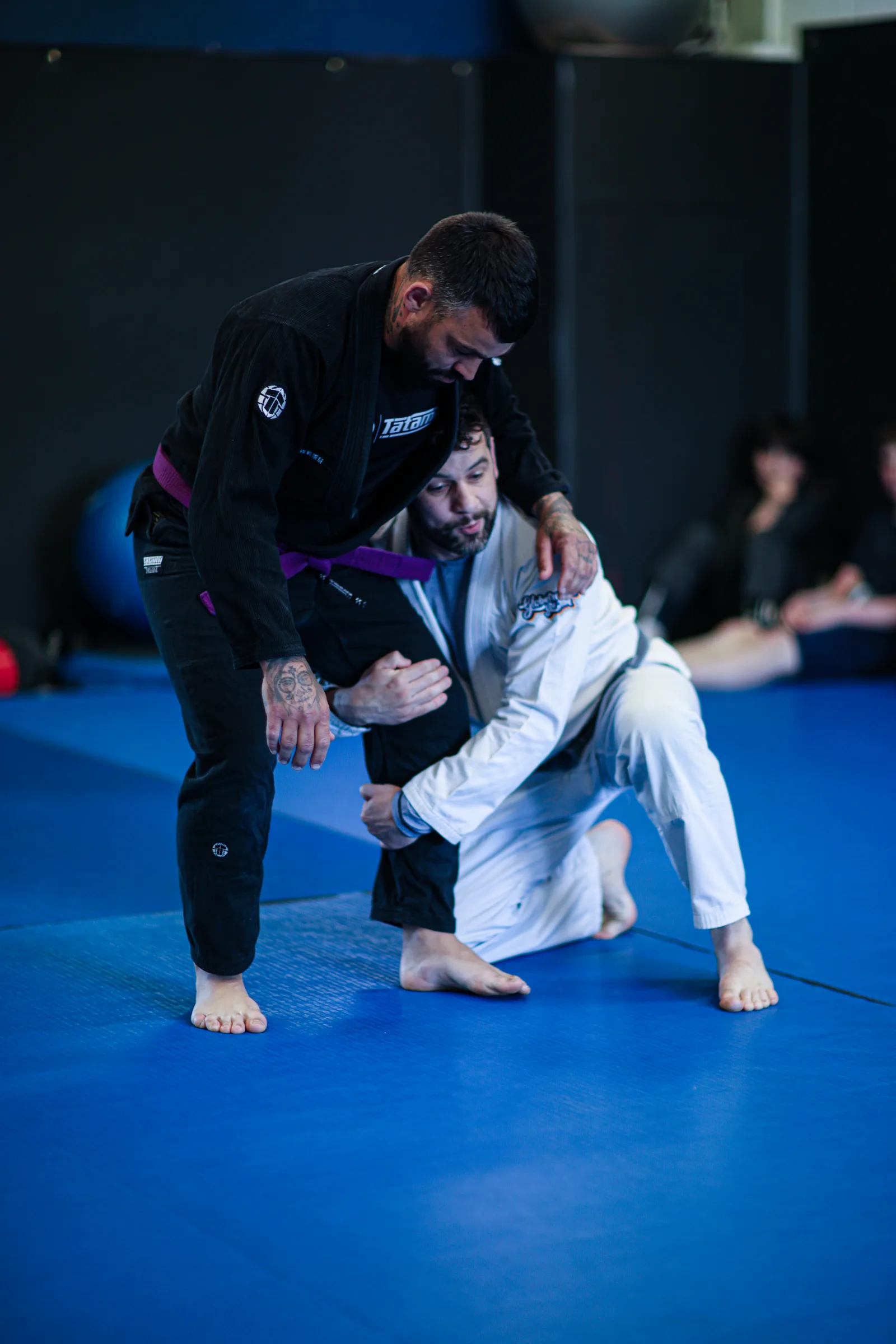
Brazilian Jiu-Jitsu and Judo Classes
Learn how Brazilian Jiu-Jitsu and Judo influenced modern gi grappling at Stoke's most highly reviewed martial arts club.

What is Gi Grappling?
Gi grappling is a ground-based martial art where both practitioners wear a traditional uniform called a gi (or kimono). The gi consists of a heavy cotton jacket, reinforced trousers, and a cloth belt that signifies rank.
Unlike wrestling or no-gi grappling where practitioners rely primarily on body contact, hooks, and athletic speed, gi grappling explicitly allows you to grab, pull, and leverage your opponent’s uniform.
A collar grip can be used to control your opponent’s posture or set up a choke. A sleeve grip can prevent an attack or initiate a sweep to reverse positions. Because the heavy fabric creates friction and offers countless handles, gi grappling slows the pace down, shifting the advantage away from raw athleticism and towards strategy, technique, and leverage.
The Historical Roadmap: From Feudal Japan to a Global Sport
To understand gi grappling today, it helps to trace its journey across four distinct chapters:
1. Classical Japanese Jujutsu
The origins trace back to feudal Japan. Samurai developed jujutsu as an unarmed combat system for the battlefield when weapons were lost or impractical against armoured opponents. Because striking an armoured opponent was ineffective, samurai focused on throws, joint locks, and positional control to neutralise threats.
2. Kano Jigoro and the Birth of Judo (1882)
In the late 19th century, master Kano Jigoro refined traditional jujutsu into Judo. Kano removed dangerous lethal techniques to focus on safe, full-contact sparring (randori) and physical conditioning. He introduced the modern heavy-duty uniform (the judogi) to withstand intense pulling and throwing. Judo emphasised dynamic throws (nage-waza) and leverage, proving that a smaller practitioner could defeat a larger opponent through timing and technique.
3. The Brazilian Jiu-Jitsu (BJJ) Expansion
In the early 20th century, Japanese judoka Mitsuyo Maeda travelled to Brazil, where he taught his fighting system to Carlos Gracie, the Gracie family, and their peers. They modified these judo techniques, shifting the primary focus away from stand-up throws and towards ground grappling (ne-waza). They proved that leverage and submission holds, such as armlocks and chokes, could force an opponent to submit regardless of their weight or strength, laying the foundation for modern BJJ.
4. Beyond BJJ: The Shift to "Gi Grappling"
In recent decades, ground fighting has expanded far beyond its original borders. Practitioners worldwide have integrated elements from Sambo, catch wrestling, Olympic Judo, and modern sport innovations.
Because practitioners from all over the globe have contributed to this rapid evolution, many coaches and academies now lean towards the broader term "Gi Grappling." It acknowledges that the art has transcended a single region or style, becoming a truly global combat sport enriched by cross-disciplinary techniques.
How Gi Grappling Differs from Other Martial Arts
If you are evaluating different martial arts, understanding how gi grappling operates compared to other disciplines helps set expectations for your first session.
Gi Grappling vs. Striking (Kickboxing, Muay Thai, Boxing)
-
Impact vs. Control: Striking arts rely on punches, kicks, knees, and elbows to generate power through impact. Gi grappling involves no striking. Instead, the goal is to control distance, take the fight to the ground, and secure a dominant position.
-
Adrenaline vs. Mindset: Striking requires sharp reactions and managing physical impact. Gi grappling feels more like physical chess. When trapped in a difficult position, panic won't save you; methodical problem-solving and understanding leverage will.
-
Longevity and Safety: Because sparring (rolling) in gi grappling can be done at full intensity without blows to the head, practitioners can train safely and continuously well into their later years.
Gi Grappling vs. No-Gi & Wrestling
-
Grips & Friction: In wrestling or no-gi jiu-jitsu, slippery rashguards and sweat make escape easier and favour quick, explosive movements. In a gi, every piece of fabric is a hold. You can grab lapels, sleeves, and trousers to pin, sweep, or submit.
-
Pacing: The extra friction and grips in the gi make it harder to slip out of bad positions, rewarding tactical patience and deep technical knowledge.
Getting Started in Stoke-on-Trent
At Totem Jiu-Jitsu Academy in Stoke-on-Trent, gi grappling classes cater to all experience levels, from absolute beginners taking their first steps to experienced practitioners sharpening their skills.
Training in the gi builds real-world self-defence skills, practical physical fitness, and a sharp, problem-solving mindset within a supportive community.