
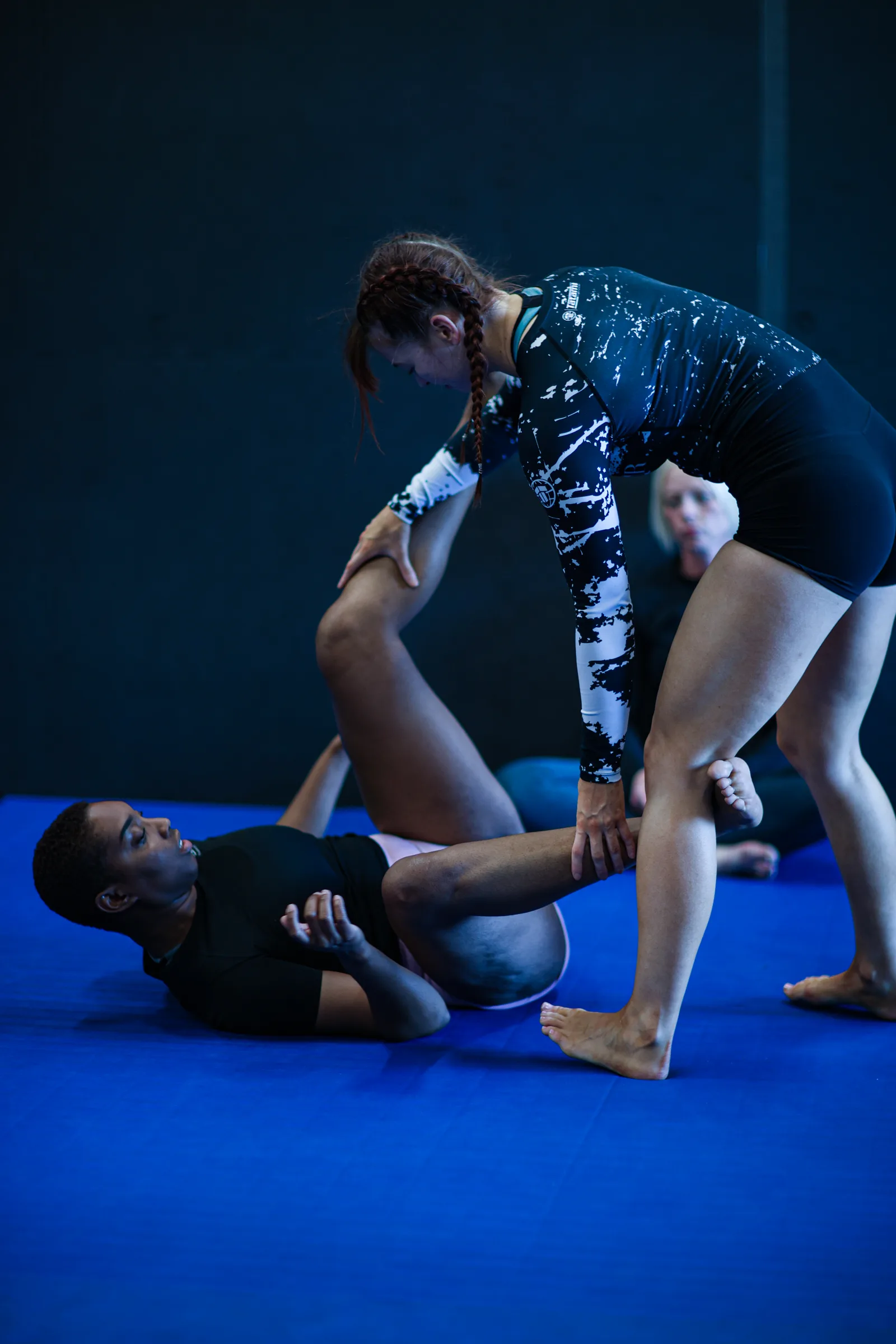
No-Gi Jiu-Jitsu and Wrestling Classes
Learn how Brazilian Jiu-Jitsu and Wrestling influenced modern no-gi grappling at Stoke's most highly reviewed martial arts club.

What is No-Gi Grappling?
No-gi grappling is a ground-based combat sport where practitioners train without the traditional kimono, instead wearing athletic clothing such as a fitted rashguard and board shorts or spats.
Unlike gi grappling, where heavy fabric, collars, and sleeves provide constant handles and leverage, no-gi explicitly forbids holding onto clothing. Instead, you rely strictly on natural anatomical controls: overhooks, underhooks, wrist control, collar ties, and body locks.
Without fabric to create friction or anchor an opponent, no-gi grappling moves at a significantly faster pace. Sweating makes surfaces slippery, escapes easier, and scrambles more explosive. The result is a discipline where athletic positioning, smooth transitions, and seamless body mechanics take centre stage.
The Historical Roadmap: A Fusion of Global Grappling Arts
While gi grappling evolved heavily through the single lineage of classical Japanese Judo into BJJ, no-gi grappling is the product of a massive global cross-pollination across several distinct grappling traditions, with Brazilian Jiu-Jitsu serving as its technical backbone:
1. Catch-as-Catch-Can & Folkstyle Wrestling
The aggressive roots of modern no-gi can be traced to submission wrestling traditions like Catch Wrestling, developed in 19th-century Britain and North America. Catch-as-catch-can emphasised relentless pressure, explosive takedowns, and vicious joint locks ("hooks"). Concurrently, scholastic and collegiate folkstyle wrestling developed the intricate riding times, turn breakdowns, and pin controls that dominate modern no-gi positional control today.
2. Luta Livre and the Brazilian Jiu-Jitsu Rivalry
While the Gracie family popularised gi-based Jiu-Jitsu in Rio de Janeiro, a parallel no-gi submission style called Luta Livre emerged in the same city. Founded by Euclydes Hatem in the 1930s, Luta Livre practitioners trained exclusively in shorts, focusing on submission wrestling and ground control. The historic rivalry between BJJ and Luta Livre in Brazil forced Brazilian Jiu-Jitsu practitioners to strip off the gi and adapt their guard systems, sweeps, and submissions to an unarmoured opponent, creating the foundation for BJJ's dominant presence in no-gi combat.
3. The ADCC Era and Brazilian Jiu-Jitsu Dominance
In 1998, the Abu Dhabi Combat Club (ADCC) created a neutral, professional tournament designed to pit wrestlers, judoka, BJJ black belts, and catch wrestlers against one another under a unified no-gi rule set.
While Sambo introduced lower-body submissions in the Soviet military and catch wrestlers brought early neck cranks, it was Brazilian Jiu-Jitsu practitioners who adapted their sophisticated guard and back-take systems to dominate these early multi-discipline events. ADCC proved that BJJ's positional hierarchy was essential for controlling elite athletes without a jacket.
4. John Danaher, the Death Squad, and the Modern Leg Lock Revolution
While early leg attacks existed in Sambo and catch wrestling, leg locks were long treated as low-percentage "hail mary" moves in traditional BJJ. The true leg lock revolution happened much later, led by coach John Danaher and his team, the Danaher Death Squad (DDS).
By applying a systematic approach to leg entanglements (ashi garami) and breaking down the mechanics of the heel hook, Danaher shifted no-gi grappling forever. This modern system transformed lower-body attacks from crude submissions into an exact science, completely reshaping how no-gi BJJ is practiced at the elite level today.
How No-Gi Grappling Differs from Other Martial Arts
If you are evaluating different martial arts, understanding how no-gi grappling operates compared to other disciplines helps set expectations for your first session.
No-Gi Grappling vs. Striking (Kickboxing, Muay Thai, Boxing)
-
Impact vs. Clinch & Control: Striking disciplines focus on striking from distance using fists, shins, and elbows. No-gi grappling contains no strikes; instead, you immediately close the distance to secure a tie-up, take the opponent down, and dominate position through leverage and body weight.
-
Flow vs. Reflexes: While striking requires rapid timing to avoid getting hit, no-gi grappling emphasises fluid problem-solving inside fast-paced scrambles. You learn to stay calm when sweating, slipping, or defending off your back.
-
Conditioning: Because there is no striking impact to the head, you can test your techniques at full physical intensity against fully resisting partners while minimising collision-based injuries.
No-Gi Grappling vs. Gi Grappling
-
Speed & Scrambles: Without the heavy friction and grips of a gi jacket, practitioners slip out of submissions and bad positions much faster. Matches feature more scramble situations, frequent stand-up re-engagements, and explosive positional changes.
-
Control Hubs: Instead of grabbing lapels or trousers, control in no-gi relies on wedging hips, controlling the back, securing the head and arm, or isolating limbs using arm-pummelling and leg entanglements.
-
Leg Lock Prominence: The lack of upper-body fabric handles makes modern leg attack systems (heel hooks, kneebars, toe holds) a cornerstone of the no-gi system, offering equalising submission opportunities from almost any position.
Getting Started in Stoke-on-Trent
At Totem Jiu-Jitsu Academy in Stoke-on-Trent, no-gi grappling classes cater to all experience levels, from complete beginners stepping onto the mat for the first time to experienced martial artists refining their submission wrestling.
Training in no-gi builds functional athleticism, high-level cardiovascular endurance, practical self-defence awareness, and a sharp, adaptive combat mindset within an inclusive team environment.